Nexus Point Quick Commerce
 Python
 The Quick Commerce Challenge
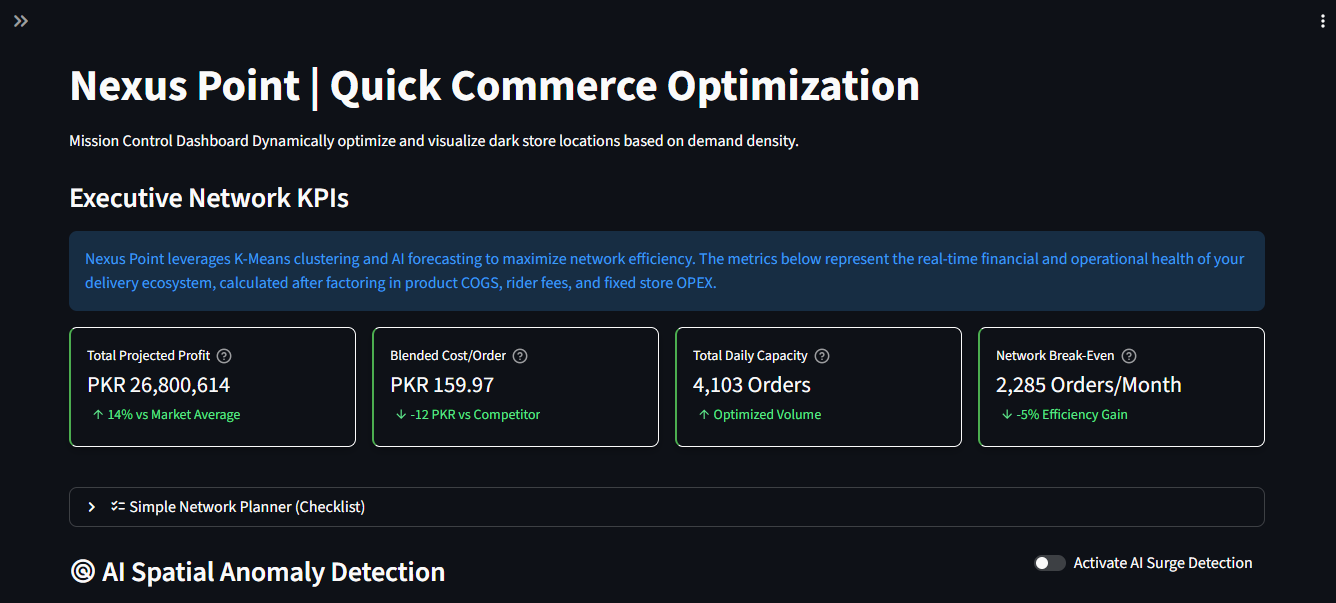
In the hyper-competitive landscape of under-20-minute delivery, profitability relies entirely on highly optimized network geometry and fleet utilization. Guesswork in hub placement or rider scheduling results in massive cash burn. Nexus Point was engineered to eliminate this guesswork by transforming raw transaction logs into actionable, predictive unit economics.
Geospatial Intelligence & ML (The Core Engine)
Built entirely in Python, the platform leverages sophisticated data science libraries to dictate physical operations:
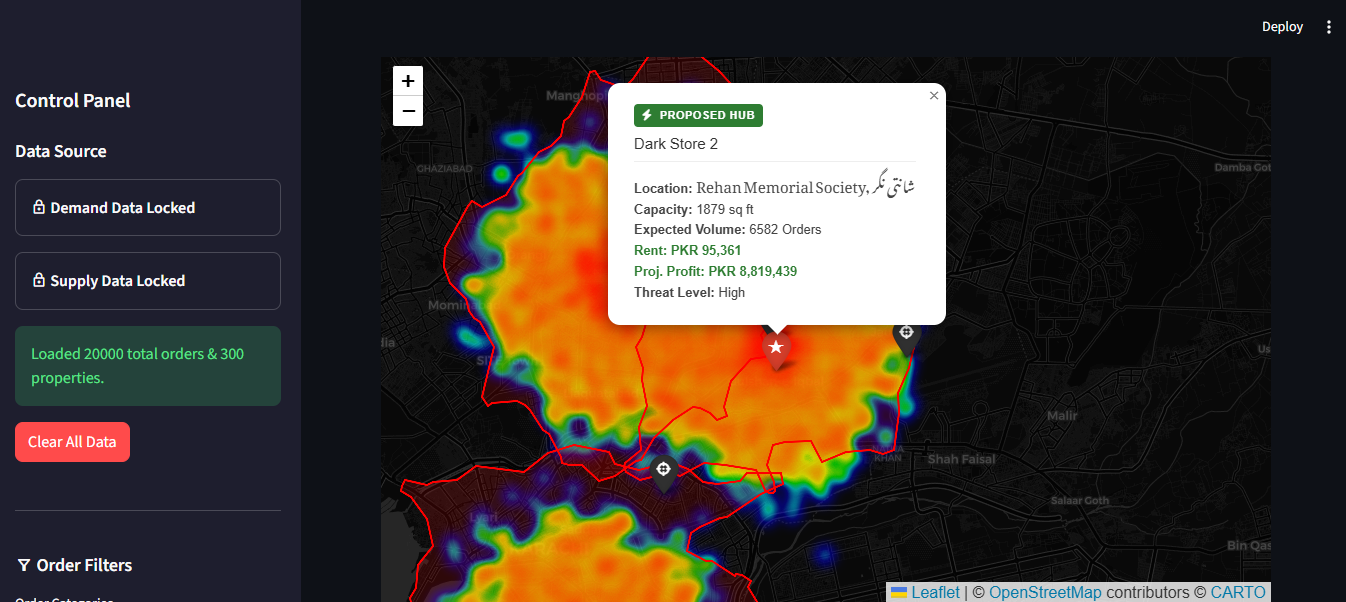
Ingests live demand data and utilizes Scikit-Learn's K-Means clustering to recommend the absolute optimal locations for new "Dark Stores" based on geometric centroids.
Deploys an Isolation Forest algorithm to detect highly-localized flash surges, allowing managers to dynamically route riders to hot zones before bottlenecks occur.
Integrates Facebook's Prophet ML model to translate time-series order volume into exact, hourly human headcount requirements for rider fleets.
Strategic Revenue Auditing
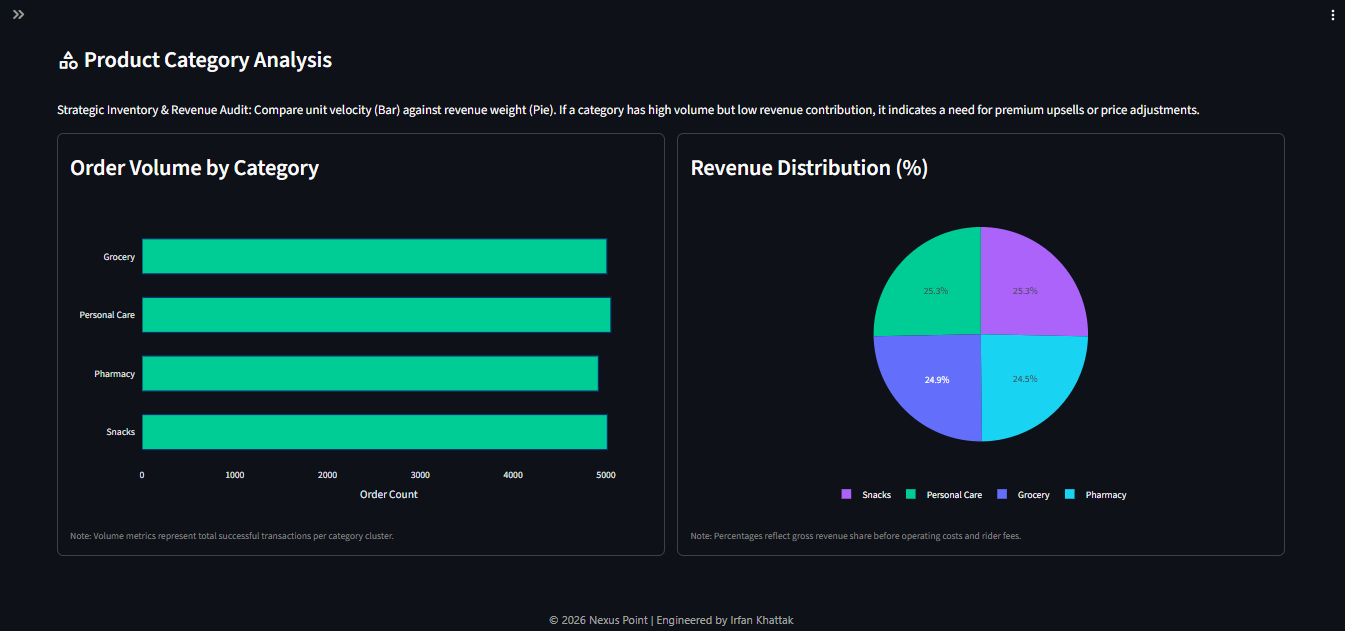
To maintain positive unit economics, the platform continually analyzes product category performance. By contrasting raw unit velocity against actual revenue weight, the system automatically flags high-volume, low-margin items that require immediate price adjustments or premium upsells.
Live Unit Economics & AI Strategy
Instead of just visualizing data, the dashboard functions as an active financial simulator. By adjusting variables like Average Order Value (AOV), Rider Fees, and Fixed Store OPEX, operations managers can instantly recalculate Projected Profit, Blended Cost per Order, and Network Break-Even margins in real-time.
Furthermore, Nexus Point integrates directly with Google Vertex AI. The system digests the mathematical outputs of the dashboard and generates human-readable Executive Strategy Cards, advising stakeholders on localized competitor threats and high-velocity product categories.
Live Simulator: Q-Commerce Unit Economics
Blended Cost Per Order
PKR 450
Daily Break-Even Volume
84 orders/day
Projected Daily Profit
PKR 35,000